Even when you have help with childcare and cleaning, there is still so much that falls on you. This week on On Her Way, I talked with my friend and fellow Bethesda mom, Khushali Shah of Canopy Families. After years working in government, she wanted more flexibility and built a business to help other families find some too. She shared how she started small, paid her team fairly, and gave herself permission to change course.
Quick takeaway: Just because something was the plan does not mean it has to stay the plan. Start small, take a calculated risk, and lean on other women.
From Government to Entrepreneurship: Who Khushali Shah Is
Khushali grew up outside Chicago, obsessed with how government ran. She moved to the Washington, DC, area and worked at the State Department, the Office of Management and Budget, and the US Mission to the UN. She also served as a COO.
Those jobs were exciting, but she was always on. She worked from 7:30 in the morning to 7:30 at night, and she says she was not getting to the gym or eating well. After she had her son, she wanted more flexibility. She had watched her husband start companies, and she wondered, why not me?
She asked what problem she could solve with her operations background. The answer came from her own life.
The Mental Load of Running a Home
Khushali Shah, founder of Canopy Families, noticed that parents often cover childcare and deep cleaning, yet many tasks still slip. Her company provides household support for busy families. It handles tasks like these:
Laundry that is clean but never folded and put away
Grocery runs and errands
Returns that sit in the car
Decluttering playrooms and organizing closets
She explained what it feels like.
“I hear the stories of, my laundry is clean, it just sits in the basket and it doesn't get folded and put away. Sometimes I need these groceries and I don't get there, and so I'm DoorDashing things at the last minute. I have Amazon returns that just sit in my car until a month has passed and I can't return them anymore. Or you stare at the playroom and you're like, wow, he's outgrown these toys, but when do I have four hours to cull everything and figure out how to donate and then put it in a box and take it somewhere? I don't have that, because I want to spend that four hours taking him to activities or creating memories and not cleaning a playroom. But at the same time, I want a calm home.”
Starting a Small Business: Testing the Idea Before Launching
Canopy Families founder Khushali Shah did not jump in. She spent a year testing the idea. She ran a survey and threw ideas at friends, asking them to poke holes in it. Because she sells a service, not a product, she did not need inventory, machines, or a storefront. The worst case, she thought, was that it would not work out.
She says her risk tolerance is real, even though people assume a government career means low risk. For her, it is a calculated risk. What is the downside? If it does not work, stop.
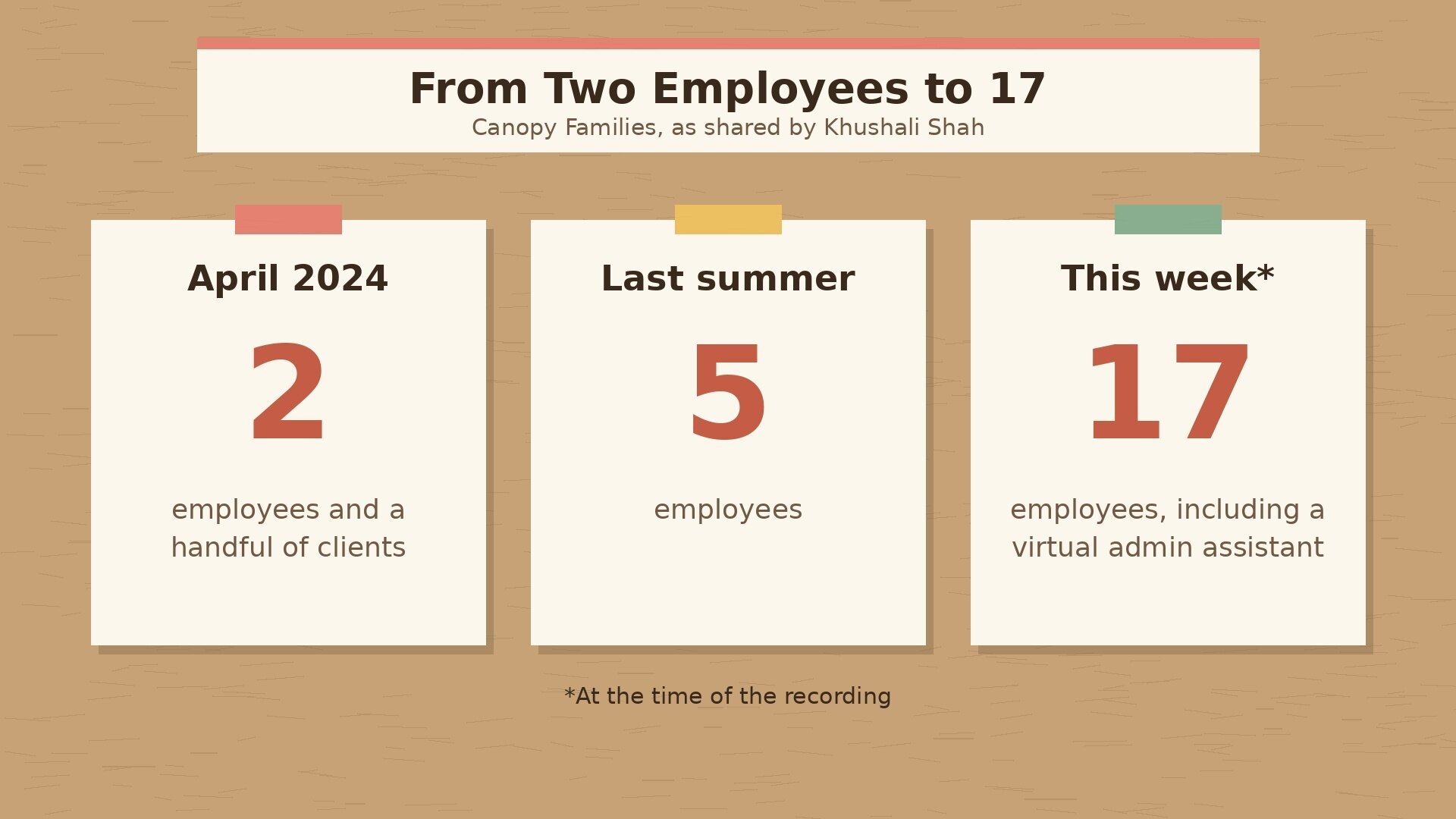
Canopy Families launched in April 2024 with two employees and a handful of clients. Last summer it had five employees. At the time of our conversation, it had 17, including a virtual admin assistant.
Fair Pay and Benefits for Household Workers
I love that Canopy Families employees are W-2 earners. Many families pay household help under the table, and Khushali wanted to do it above board. That was part of her mission. She also noted that handling payroll is one more task you add to a parent's plate.
“I want them to have something, so that when they're 50 or 60 years old, whenever they want to retire, they have paid into Social Security, they have paid into Medicare. The state of Maryland for small businesses has created something called Maryland Saves. And a living wage is important, so we're not paying them minimum wage, we're paying them more, so that they can also live their lives. We don't work weekends. We try not to work on the evenings unless it's a special ask. If we do that, I pay them overtime, because the idea is I do want them to also have their own life and be able to be with their families.”
Employees can save throughMaryland Saves, which she says does not require an employer match. She is not offering one yet. She also tries to price fairly, since clients pay with after-tax dollars. Employees get sick leave and holiday pay, and she offers fair pay and benefits for household workers as a core value.
How Canopy Families Works
The structure is simple:
Choose a time block. The minimum is two hours.
Get a consistent person. You are matched with the same person, day, and time.
Share notes your way. Text, a note, or a shared phone note all work.
Pay after the work. You are charged at the end of the month for visits that happened.
Get a substitute if needed. If your person is out, someone else can cover.
Giving Yourself Permission to Change Course
I asked Khushali what she wants other women to hear. Her answer is the heart of the episode.
“What I've learned is that who you are at one time in your life does not have to be who you are throughout your life, right? When I think of what I wanted to do in college or in my early 20s, I don't think I would have pictured myself at this stage doing this. I thought I would have been in government forever. And it's scary. So again, the calculated risk, like you are taking those risks, but I think you have to evolve and you have to give yourself the grace to say, just because that was the plan doesn't mean it has to be the plan.”
She says change is inevitable, and it is scary but not bad. This matters to me because I changed careers myself, and I know how much goes into that choice. Changing careers as a mom often means moving without knowing exactly where you will land.
Before You Start: Questions Khushali Suggests
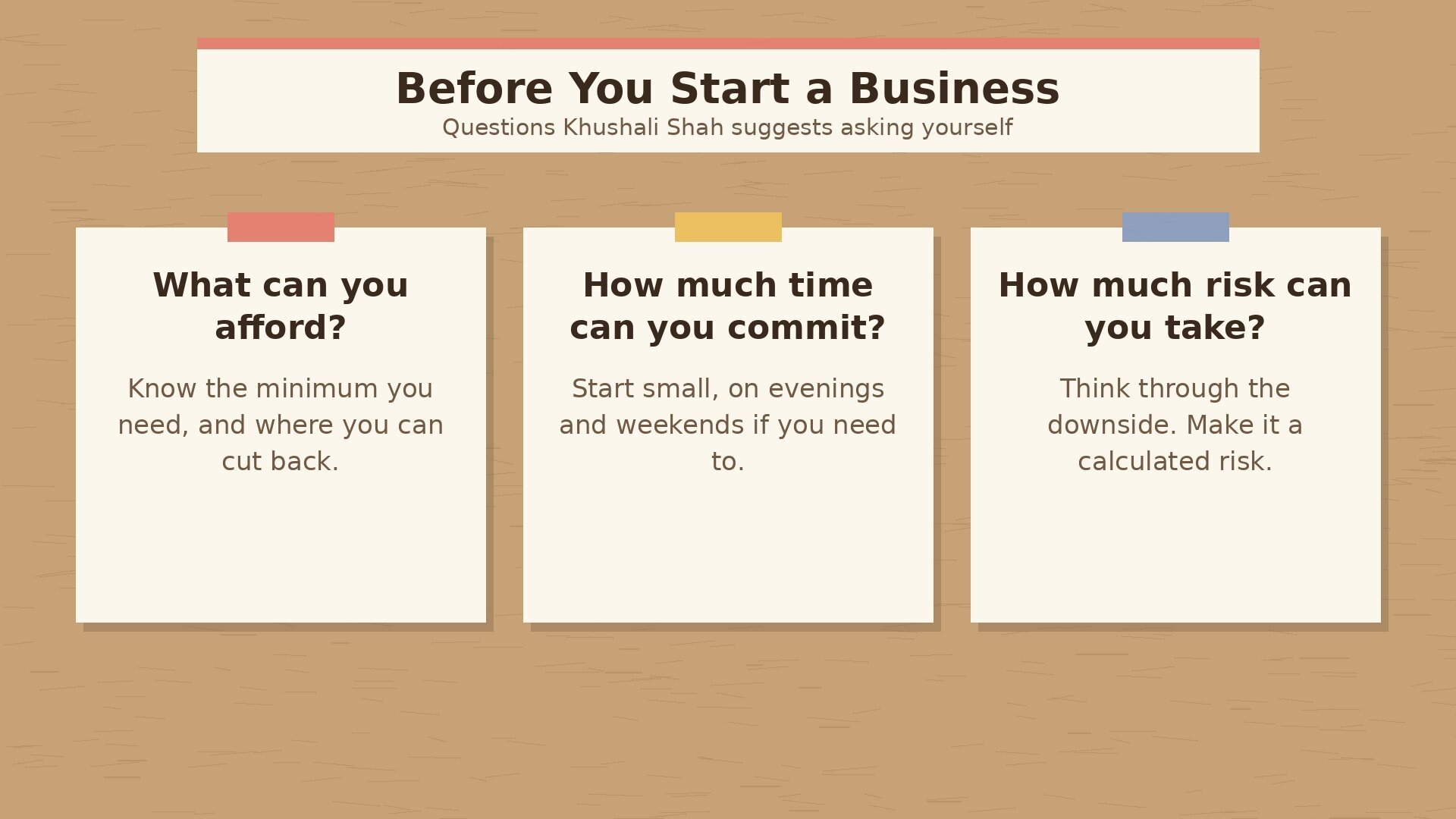
For women thinking about starting a small business, Khushali suggests asking three questions. What can you afford financially? How much time can you commit? How much risk can you tolerate? You do not have to do it all at once. You can begin in the evenings or on weekends, and slow and steady can win the race.
Image source: Original graphic created for On Her Way
Image filename: questions-to-ask-before-starting-a-small-business.jpg
Image alt text: Three questions to ask before starting a business: money, time, and risk
Building Your Community of Advisors
Khushali leaned on friends, family, and groups for women entrepreneurs. They can poke holes in your idea and share the tools they use. She says meeting other women, learning how they do things, and supporting each other has been one of the most fun parts.
Patience, Letting Go, and No Five-Year Plan
Today, Khushali says she is more patient than she was 20 years ago. She still struggles to let go, but she works on taking a breath. She makes time for downtime, health, and community.
She never had a five-year plan. When people ask how she built her career, she says she just did the next interesting thing.
Khushali's Bethesda Favorites
We ended with local love. Khushali trains atNesfield Performance, loves the desserts atTout de Sweet, and shops for gifts atThe Blue House, a local woman-owned shop. She also loves Bethesda's neighborhood Halloween parade and being close to DC museums.
Frequently Asked Questions About Canopy Families
What does Canopy Families do?
It provides household support with tasks such as laundry, errands, and organizing.
What should you ask yourself before starting a new business?
Ask what you need financially, how much time you can commit, and how much risk you can tolerate.
Who can help you think through a new business idea?
Friends, family, and groups of women entrepreneurs can poke holes in your idea and share tools.
Connect With Khushali Shah and Gitika Kaul
VisitCanopy Families or find Khushali onLinkedIn. To follow my work, visitKaul Home Group or find me onInstagram. Thank you to Khushali Shah of Canopy Families for her honesty. Keep going. You're on your way.
Apply to Be a Guest on the On Her Way Podcast
Women across Bethesda and the DC area are building, rebuilding, and figuring it out as they go. If you have a story about ambition, reinvention, or resilience, I'd love to hear from you.
This podcast is produced by the Icons of Real Estate - #1 Real Estate Podcast Network. If you are a real estate professional, apply to be a guest speaker across the network.
